


I have just realised that the stakes are myself
I have no other
ransom money, nothing to break or barter but my life
my spirit measured out, in bits, spread over
the roulette table, I recoup what I can
nothing else to shove under the nose of the maitre de jeu
nothing to thrust out the window, no white flag
this flesh all I have to offer, to make the play with
this immediate head, what it comes up with, my move
as we slither over this go board, stepping always
(we hope) between the lines
From Diane di Prima’s Revolutionary Letters (City Lights Publishers, 1971).
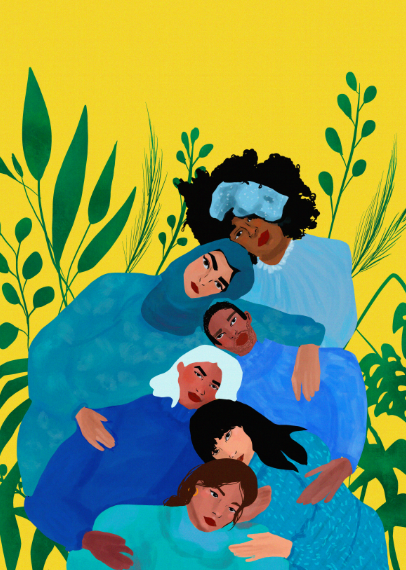
Image credit: Ipsita Divedi
‘Women’s rights are human rights’. This call, echoed by René Cassin and enshrined in international human rights law, reminds us that the safety and dignity of women are fundamental matters of justice. And as Eleanor Roosevelt once insisted, human rights begin ‘in small places, close to home’. If they do not hold there, she warned, they hold nowhere. This vision has guided René Cassin’s work during the 16 Days of Activism: to illustrate that safety begins in the places closest to us, using this lens to challenge perspectives and reveal that violence against women and girls (VAWG) is a lived reality within our homes, communities, and institutions that urgently need transformation.
In previous years, our campaigns have placed this principle into action. In 2023, we reaffirmed that ‘women’s rights are human rights’, advocating for safe spaces and amplifying the voices of women and girls from diverse backgrounds, including Roma, refugee, and Uyghur women. In 2024, we focused on equal opportunity, respect, and visibility for marginalised women, such as Uyghur women and those held in UK immigration detention, whose experiences of discrimination and violence are too often overlooked, as we partnered with Stop Uyghur Genocide and Women For Refugee Women. Each year, the message has been clear: human rights must be defended everywhere, especially for those who are marginalised. While women’s rights may not be part of Rene Cassin’s direct portfolio, we will continue to highlight women’s rights across existing campaigns and by supporting our partners.
This year, we adopt a new framing: Acts of Hope. While the persistence of VAWG demands continued vigilance, we must also articulate a hopeful vision for the future and ensure responsibility in achieving it. By centering stories of resilience, highlighting legal tools that protect women, and calling for inclusive commitments from government and civil society, we seek to transform the 16 Days into a promise of change.
Safeguarding a promise to Human Rights
On this year’s 75th anniversary of the European Convention on Human Rights (ECHR), it is vital to remember its essential framework for advancing women’s rights in the UK.
- Articles 2 and 3 guarantee the rights to life and protection from inhuman or degrading treatment, vital safeguards against gender-based violence, harassment, and exploitation.
- Article 8 protects private and family life, and has been used to challenge state failures to protect women from abuse.
- Article 14 prohibits discrimination and strengthens women’s equal standing before the law.
For refugee and asylum-seeking women, the ECHR has shaped case law requiring a safer and more humane route to protection, as secured also under the Refugee Convention (1951), and has provided a critical check on the use of immigration detention, particularly for survivors of gender-based violence. Embedded in UK law through the Human Rights Act, the ECHR represents not only a legacy of international law but also an act of hope and an ongoing promise that legal commitments can and must create a safer, more dignified future for women and girls.
Government Responsibilities and Current Policies
The UK government has pledged to halve violence against women and girls within a decade, presenting this as a central plank of its domestic safety agenda. This ambition, while welcome, remains incomplete. The promise explicitly excludes refugee and asylum-seeking women, many of whom face heightened risks of gender-based violence both in their countries of origin and within the UK’s immigration system. Policies that restrict safe routes to asylum, combined with the ongoing use of immigration detention, expose refugee women to further harm rather than offering protection.
Such exclusions undermine the UK’s stated commitment to international law, including obligations under the European Convention on Human Rights, CEDAW, and the Istanbul Convention, all of which require equal protection from violence and discrimination without distinction.
Faith communities have a particular role to play in this struggle, as there are added barriers faced by women of faith, which need tailored responses within every community. Jewish teaching demands that the pursuit of justice (tzedek, tzedek tirdof) includes ensuring safety and dignity for all. Acts of hope can be found in the way Jewish and other faith-based organisations challenge silence, support survivors, and advocate for systemic change.
A Call To Action
The 16 Days of Activism remind us that violence against women and girls is not inevitable; it is preventable. International law, from the European Convention on Human Rights to the Istanbul Convention, gives us the framework. Faith traditions and teachings present us with the moral imperative, and the courage of women themselves shows us the path forward.
Our responsibility now is to transform these tools and commitments into concrete acts of hope, rather than focusing on crises themselves. This means holding the UK government to account for its promises on safety, demanding that refugee and asylum-seeking women are not left outside protections, and ensuring that all women, of every background and faith, can live free from violence and fear.
Hope is not passive; it is an active promise. Each step taken to protect, to include, and to uphold dignity is an act of hope that builds a safer future. Let this be our collective commitment: to ensure that women’s rights are recognised not only on paper, but in everyday life in ‘small places, close to home’.