


By Debora Singer MBE
I first went on a demonstration when I was 18. I went with my Mum. It was 1976, we were in Harrow, and the demonstration was called by the anti-Nazi league against the National Front.
When my mother was in her 80s, she went on her own to demonstrate at the local Harrow mosque, to support an extension. The English Defence League (EDL) were going to demonstrate against this. My mother told me she sat on a low wall and chatted to some of the younger Muslim people there. A police officer told her there was going to be trouble and she should go home, but she stayed. As a Jewish refugee from Nazi Germany, she knew about religious persecution.
The most recent demonstrations I have been on were organised by Stand Up To Racism. One was in support of refugees because of the increase in government rhetoric against them. The other was in North Finchley near an immigration advice centre where the far right was expected to demonstrate. My sign read “My Family were Refugees too”. The turnout filled the length of the pavement on one side of the street. On the other side of the street, one man with an England flag hung over his shoulders was talking to the police.
Since October 7th, I have avoided marches. My thoughts on Palestine are too nuanced to fit into the slogans of the big regular matches. But when I saw the list of organisations supporting the rally against antisemitism to be held outside Downing Street on Sunday, 10th May, I felt happy to join in. Backed by 30 organisations, including Rene Cassin, the Jewish voice for Human Rights, where I volunteer, the main organisers were the Board of Deputies of British Jews and the Jewish Leadership Council.
Surprisingly, it wasn’t my Jewish friends who alerted me to the rally. It was a non-Jewish woman from my local women’s rights group who got the information from the British Friends of Israel. Which is how I ended up going to the rally with two non-Jewish women. It felt really supportive to be there with people who had no personal link to Judaism, but who understood the rights of a minority to live in freedom.
People have likened current times to Nazi Germany in the 30s. But in the 30s, it was the German government that passed the Nürnberg laws and restricted the rights of Jewish people. It was the state that caused Kristallnacht, the night of broken glass. And at that time, nobody would have been allowed to attend a march for the rights of Jews as we were doing.
Looking around, I could see many obviously Jewish people, older, rather than younger. There were Union Jacks and Israeli flags, outnumbered by the Iranian lion flag. As we entered Whitehall via security arches and bag searches, a man on the stage was playing Hava Nagila and Shalom Aleichem on a portable digital keyboard. There were numerous speeches by the leaders of our political parties and rabbis of all denominations, as well as a bishop and the founder of Tell Mama UK, which supports people affected by Islamophobia.
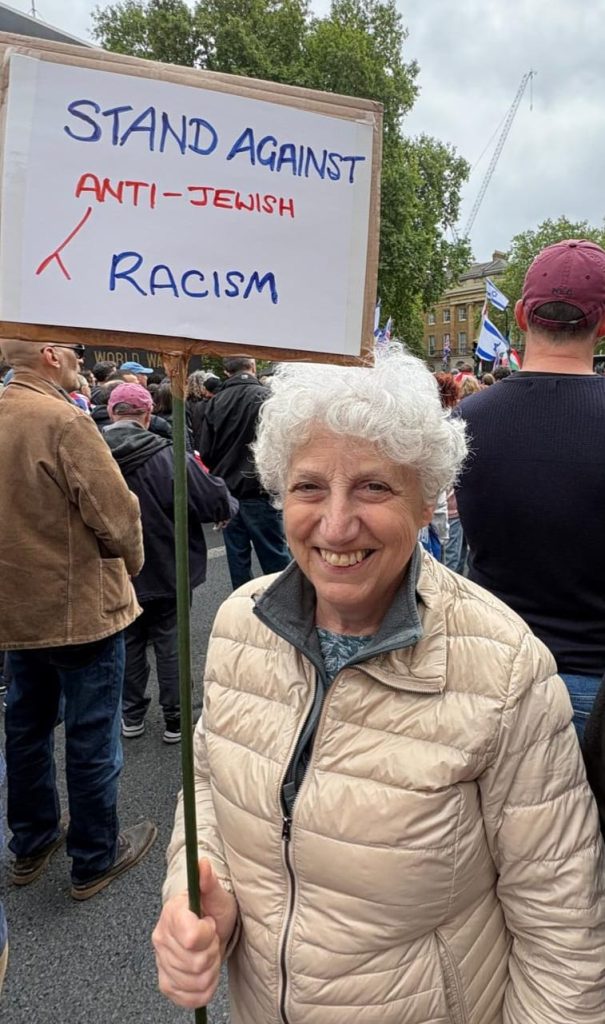
But where were the rest of the Muslims? Where was the Muslim Council of Britain or other similar organisations? Or even a local imam who had shared his mosque with the neighbouring Jewish congregation? Many speakers talked about the importance of the fight against radical Islamism. They demanded the banning of the IGRC (Iranian Revolutionary Guard) and the Muslim Brotherhood.
And where were the left-wing allies? Where were Stand Up To Racism? My hand-made sign read “Stand Against anti-Jewish Racism”. Where were the unions, the human rights charities, the supporters of Black Lives Matter, and the socialist groups?
My women’s rights group was incredibly supportive, as was the street I live on and my personal friends, Jewish and non-Jewish. I was glad I went to the rally. It felt important to stand up and be counted. I left with a huge sense of solidarity from the non-Jewish people I’d seen there. But I was also left with a sense of isolation at the lack of response from all the left-wing organisations I support.
