


By Debora Singer, MBE
The ITV drama series, Believe Me, has reminded us of how the Human Rights Act can protect people who become survivors of crime.
The series focuses on the notorious case of John Worboys, the London taxi driver who raped numerous women between 2003 and 2008.
The story starts in 2003 when DSD went to the police to report being raped by a London taxi driver. This was the first such case to be reported to the police. DSD told the police that the taxi driver told her he had won a cash prize and asked her to join him in a celebratory drink of champagne. The drink was spiked, and when she woke up, she realised she had been raped.
The police failed to believe her. DSD reports the police officer as saying, “A black cab driver wouldn’t do that.”
Over the next few years, a dozen women reported similar cases to the police. What followed was a catalogue of police failings. These included failing to take the women seriously, to interview witnesses, to collect relevant CCTV evidence and to establish links between the many similar complaints they were receiving. This resulted in Worboys continuing to be free to attack women. He was finally convicted in 2009, by which time he was believed to have raped or sexually assaulted more than a hundred women.
Whilst Worboys was eventually jailed indefinitely for these crimes in 2009, his many victims felt that they had suffered the additional indignity and trauma of being disbelieved by the police and having the investigations into their cases stalled.
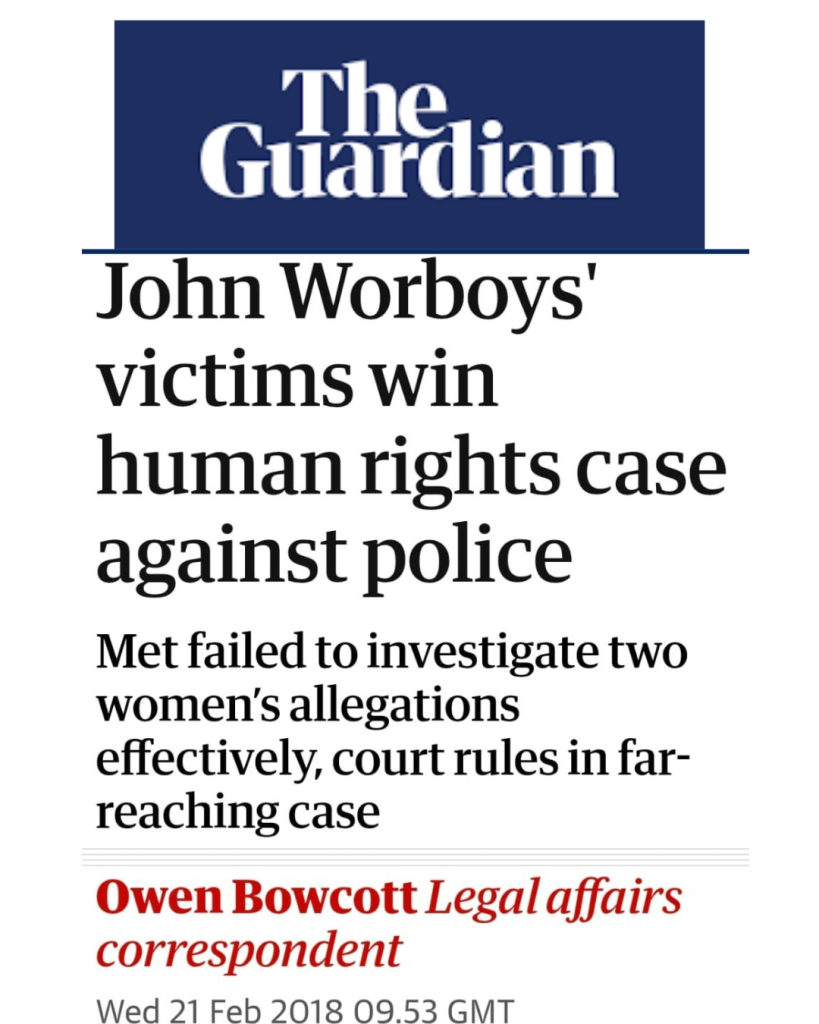
Two of the women took a new case, not concerning their treatment by Worboys, but their treatment by the Metropolitan Police. They were seeking to hold the Metropolitan Police to account.
DSD and NBV (Sarah and Leila in the TV series) argued that, by failing to investigate their cases effectively, the Metropolitan Police had breached their human rights.
The Human Rights Act does not only mean that the police should not harm you themselves. It also means that they have a positive duty to investigate if a member of the public has breached your human rights.
But the question was, how far does this requirement go?
The human right that DSD and NBV focus on is freedom from inhuman and degrading treatment – Article 3 of the Human Rights Act.
On 21 February 2018, their case was determined in the Supreme Court.
The Human Rights Act works on several levels – under Article 3, public authorities such as the police:
- must not do anything that amounts to inhuman and degrading treatment
- must put in place measures to protect its citizens from such treatment by other people
- must have a system of laws and procedures so that such treatment can be investigated, prosecuted and punished
And since the Supreme Court ruling, the police
- must conduct an effective investigation into such treatment
So, what does this case mean for survivors of the most serious crimes? And what does it mean for the police?
It means that survivors of serious crimes denied justice due to failings by the police have a right to challenge this in court.
It means that the police can be held to account by survivors when they significantly fail in their duty.
It means that it is not sufficient for the police to have procedures in place to investigate serious crimes. They have to implement these procedures.
In welcoming the Supreme Court’s decision, DSD stated that if the police had done their job properly, there would have been only one victim, not a hundred. She said that this ruling should force the police to do their job. This would increase women’s confidence to report such crimes.
Harriet Wistrich, founder of the Centre for Women’s Justice, took the case with Phillippa Kaufmann, who stated about this case:
It … undermines the false narrative that the Human Rights Act and European Convention on Human Rights (ECHR) are a barrier to protecting women and girls from male violence; on the contrary, it is often the only legal tool we have to challenge state institutions that fail them.
At a time when the future of the HRA and the UK’s membership of the ECHR is being debated, Believe Me shows what is at stake when the standards that protect victims of serious violence are weakened. The HRA/ECHR framework plays an important role in setting clear obligations on public authorities, underpinning public confidence and helping to prevent repeat harm.
This is just one example of how the Human Rights Act can help ordinary people in their ordinary lives. As well as watching Believe Me, you can see short films about two other Human Rights Act cases here.
