


The Refugee Convention Timeline
Jewish communities around the world carry in our hearts a millennia-long history of fleeing persecution and seeking safety. At Pesach Seder tables, we recount the ancient Israelites’ exodus from Egypt. In schools, we teach the horrors of the Holocaust, hoping that history will not repeat itself.
On July 28 2026, we recognise the 75th anniversary of the 1951 Refugee Convention, initially established to provide solutions for the millions displaced in Europe following World War II and the Holocaust. The Convention defines refugees as persons with “a well-founded fear of being persecuted for reasons of race, religion, nationality, membership of a particular social group or political opinion.” It guarantees protection of human rights and that refugees shall not be returned to the states where their safety could be threatened.
Click through the timeline below to read more about the events preceding the Refugee Convention and some of the populations who subsequently used the Refugee Convention when they sought refuge in the UK.

Aliens
Act
1905
Click to learn more
Aliens
Restriction Act
1914
Click to learn more
Evian
Conference
1938
Click to learn more
Kinder- transport
1938-1939
Click to learn more
Universal
Declaration
of Human Rights
1948
Click to learn more
Refugee
Convention
1951
Click to learn more
Hungarian
Refugees
1956
Click to learn more
Vietnamese
Refugees
1975
Click to learn more
Sri Lankan
Tamils Refugees
1983
Click to learn more
Kosovan Refugees
1998
Click to learn more
Sudanese
Refugees
2005
Click to learn more
Syrian
Refugees
2014
Click to learn more
Afghan
Refugees
2021
Click to learn more
Ukrainian Refugees
2022
Click to learn more
2026
Click to learn more
Conclusion
The 1951 Refugee Convention was a landmark achievement in international human rights law, establishing a vital legal framework that guarantees protection, dignity, and rights for those fleeing persecution. Yet legal protections alone are not enough.
As we mark the Convention’s 75th anniversary, an estimated 117.3 million people worldwide remain forcibly displaced. The greatest challenge today is not the absence of rights n paper, but the lack of safe and accessible routes through which people can claim those rights in practice. In the UK, increasingly hostile rhetoric surrounding refugees and asylum seeker sin political debate, sections of the media, and public discourse has been accompanied by a system under significant strain. More than 80,000 asylum appeals remain unresolved, leaving thousands of people trapped in prolonged uncertainty and unable to rebuild their lives with security and dignity. The Ukraine Family Scheme and Homes for Ukraine programme demonstrate what is possible when governments establishing safe and legal pathways to protection, while also underscoring how limited such routes remain for most people seeking refuge.
To fulfill the promise of the Refugee Convention, the UK government must do more than simply uphold its legal obligations. It must create and expand safe, accessible routes to protection, ensuring that people are not forced to risk their lives in order to exercise rights that international law already guarantees.
On this anniversary, we are reminded of the Jewish imperative to welcome the stranger, and we recommit to defending the legal rights of refugees and asylum seekers, and to advocating for the humane and practical pathways that make those rights meaningful in reality. Only then can we truly honour the vision and principles at the heart of the Refugee Convention.
2026
On the 75th anniversary of the Refugee Convention, it is interesting to analyse this history.
The first laws on immigration used the term “alien” and were created to keep foreigners, mainly Jews, out of Britain. The Evian Conference failed to protect Jews suffering persecution in Europe.
The first safe route for refugees was the Kindertransport, but it was restricted to children.
Following the Holocaust, the need to protect from persecution became recognised. Two international treaties covered the right to asylum, the Universal Declaration of Human Rights (1948) and the Refugee Convention (1951).
Since then, the legal framework has been clear. The 1951 Refugee Convention defines who a refugee is and obliges States to protect refugees. It also protects people from being sent back to places where they face persecution or serious harm
Individuals or families arriving in the UK fleeing persecution have the right to claim asylum and to have their claim considered under the Refugee Convention. However, as they can only claim once they in the UK, this leaves them to take perilous journeys to reach the UK, whether by plane, lorry or boat.
When major conflict or persecution against a particular group result in greater numbers of people seeking protection, the government sets up schemes specifically to provide a safe route and protection for those refugees.
When safe and controlled routes are established, they provide life-saving pathways for people fleeing persecution and conflict. Their success often depends on coordination between governments, international institutions, and civil society, demonstrating that humane and managed responses to displacement are both possible and effective.
In recent years, however, such routes have remained limited and unevenly applied. Public and political discourse has increasingly challenged their viability, particularly where narratives portray people seeking safety in negative or dehumanising terms.
Despite this, there are clear precedents for safe routes operating with public support in the United Kingdom, including resettlement and sponsorship schemes introduced in response to specific crises. These examples highlight the capacity of government policy to translate the principles of refugee protection into practical access to safety.
Expanding and systematising safe routes, particularly for individuals and families fleeing persecution, remains a key challenge for policymakers. Ensuring that the rights guaranteed under the Refugee Convention can be meaningfully realised requires not only legal protections but also accessible and humane pathways to reach them.
Ukrainians in the UK 2022
Following the Russian invasion of Ukraine in 2022, many Ukrainian women and children crossed the border into Poland. In response to this the UK government established the Homes for Ukraine and the Ukraine Family visa schemes. The Ukrainians are not technically refugees although they are fleeing war, but this mechanism has provided a safe route for them to reach safety. Approximately 234,000 individuals have come to the UK under these schemes, most arriving in 2022.
The government stopped accepting new applications to the Ukraine Family Scheme in February 2024, and further restricted eligibility requirements for sponsors under the Homes for Ukraine Scheme. Ukrainians in Britain are eligible to extend their 18-month visas through the Ukraine Permission Extension Scheme, but are ineligible for permanent residence.
Afghan Refugees 2021
The Home Office set up the Afghan Resettlement Programme (ARP) to streamline three Afghan resettlement schemes, largely serving Afghan Nationals who worked with the UK Government. Approximately 38,000 people were resettled or relocated under the Afghan Resettlement Programme between 2021 and March 2026. However, the UK has since made changes to the ARP to bring an end to Afghan relocation services, severely limiting safe routes and increasing risk for an already vulnerable population.
Syrian Refugees 2014
In response to the Syrian civil war, the UK government launched the Vulnerable Persons Resettlement Scheme (VPRS), which safely relocated thousands of refugees from the region. In 2017, the scheme was expanded in scope to include those who had fled violence in Syria, but did not have Syrian nationality. From the creation of VPRS in 2014 until its conclusion in 2021, over 20,000 refugees were safely resettled in the UK.

Mohammed and his children Mohammad Murad, Aisha, and Oweis were resettled in Scotland. Photo: Andrew McConnell, UNHCR
Sudanese Asylum Seekers 2005
Millions of Sudanese nationals were displaced by ongoing violence and human rights atrocities around 2005. . Despite years of activism by human rights advocates, including by René Cassin and other civil society organisations, there are still very limited safe and legal pathways for Sudanese asylum seekers to find safety in Britain. Most recently, according to the Refugee Council, 12% of arrivals via small boats between April 2025 and March 2026 were Sudanese nationals.
Kosovan Refugees and Asylum Seekers 1998
The outbreak of the Kosovo War led many nationals of the Federal Republic of Yugoslavia, most of them Kosovan Albanians, to seek asylum. In 1998, the UK Home Office received nearly 8,000 asylum applications. In addition to asylum seekers, UN Refugee Agency (UNHCR) oversaw the evacuation of 4,346 Kosovan refugees to the United Kingdom between April and June 1999, many of them for family reunification.
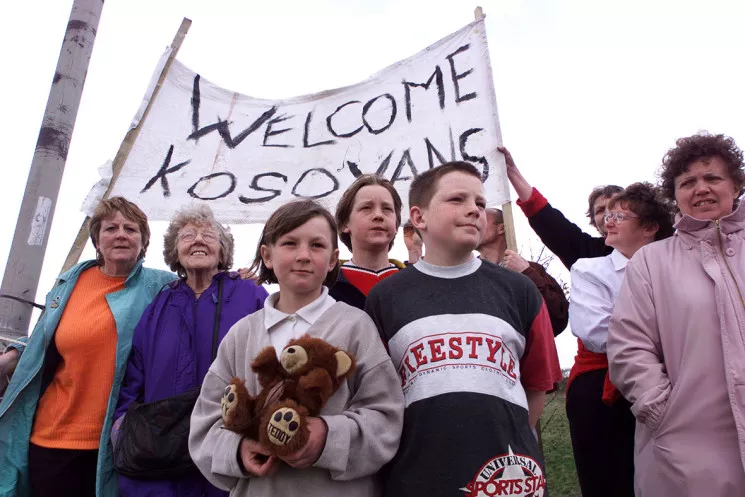
Refugees are greeted at the Leeds Bradford airport with a sign reading “Welcome Kosovans,” April 1999

Kosovan refugees, March 1 1999
Sri Lankan Tamils 1983
The prolonged Sri Lankan civil war beginning in the 1980s pushed many Sri Lankan Tamils to flee violence and seek asylum abroad, particularly in the UK due to the history of British colonial rule and subsequent membership of the Commonwealth. As Commonwealth citizens, Sri Lankan nationals were initially granted temporary entry to the UK without a visa. However, the UK government instated a visa requirement in 1985 in response to the hundreds of Sri Lankan Tamils arriving each day seeking safety. Further, the state began enforcing penalties for entities transporting travelers without visas with the passage of the 1987 Immigration (Carriers’ Liability) Bill. Attempts to exempt carriers from penalty in instances where the passenger was a refugee were unsuccessful.
Vietnamese Refugees 1975
The 1975 fall of Saigon resulted in a mass displacement and relocation of Vietnamese refugees, with an estimated two million so-called ‘boat people’ seeking refuge abroad. More than 250,000 people fleeing Vietnam died at sea.
By 1979, over 60,000 Vietnamese refugees landed in Hong Kong, which was still under British colonial rule. The Thatcher government resisted resettlement of 10,000 refugees at the request of the United Nations High Commissioner for Refugees. As reported in the Guardian, “Margaret Thatcher initially refused to give 10,000 Vietnamese boat people refuge in Britain, privately warning her ministers that there would be riots on the streets if they were given council housing,” although Thatcher later reluctantly complied. By the early 1990s, approximately 24,000 Vietnamese refugees were granted entry to the UK.

Vietnamese refugees arriving in Malaysia in December 1978. Photographer: Kaspar Gaugler
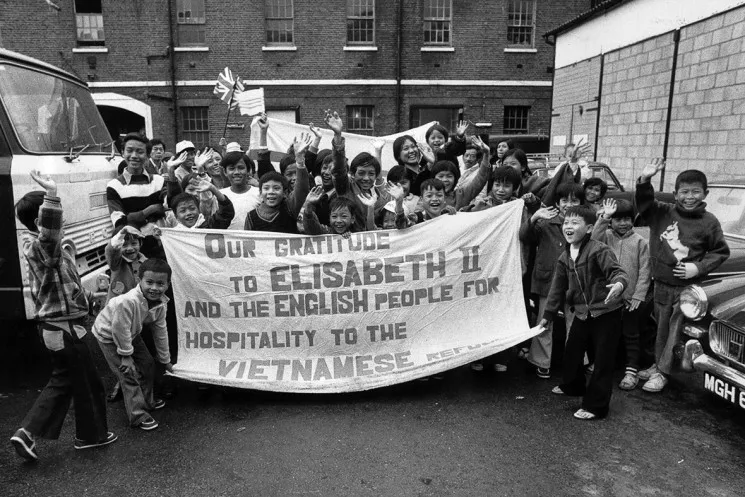
Vietnamese refugees in the UK, October 1978. Photographer: Colin Davey
Hungarian Refugees 1956
An estimated 200,000 Hungarians fled the country following the Soviet invasion of Hungary in 1956. Approximately 180,000 individuals escaped to Austria and 20,000 to Yugoslavia. The recently established United Nations High Commission for Refugees (UNHCR) facilitated the rapid resettlement of these refugees in third countries, and within three years, nearly 180,000 Hungarian refugees were resettled in 37 countries. Roughly 21,000 Hungarians fled to the UK by summer 1957, and just over 14,000 settled in Britain permanently.

Hungarian refugees traveling to Switzerland
Refugee Convention 1951
A United Nations multilateral treaty approved on July 28, 1951, the Convention Relating to the Status of Refugees defines refugees under international law as follows:
“As a result of events occurring before 1 January 1951 and owing to well-founded fear of being persecuted for reasons of race, religion, nationality, membership of a particular social group or political opinion, is outside the country of his nationality and is unable or, owing to such fear, is unwilling to avail himself of the protection of that country; or who, not having a nationality and being outside the country of his former habitual residence as a result of such events, is unable or, owing to such fear, is unwilling to return to it.”
The convention guarantees refugees the right to non-refulment (Article 33); the right not to be expelled, except under certain, strictly defined conditions (Article 32); the right not to be punished for irregular entry into the territory of a contracting State (Article 31); the right to non-discrimination (Articles 3 and 5); the right to decent work (Articles 17 to 19 and 24); the right to housing, land and property, including intellectual property (Articles 13, 14 and 21); the right to education (Article 22); the right to freedom of religion (Article 4); the right to access to justice (Article 16); the right to freedom of movement within the territory (Article 26 and Article 31 (2)); the right to be issued civil, identity and travel documents (Articles 12, 27 and 28); and the right to social protection (Articles 23 and 24 (2-4)).
The 1951 Convention initially provided protected refugee status only to European refugees displaced by World War II. However, the 1967 protocol expanded the parameters of refugee protection, removing geographic and temporal restrictions. Today, the UN Refugee Agency (UNHCR) continues to uphold the definition of a refugee and their recognition in international law as established in 1951.

Twelve nations sign the 1951 Refugee Convention
Universal Declaration of Human Rights 1948
The Universal Declaration of Human Rights, co-drafted by Monsieur René Cassin, served as a foundational document in establishing “universal respect for and observance of human rights and fundamental freedoms” by UN member states. Although the Universal Declaration was not legally binding, it resulted in the creation of over 70 regional and international human rights treaties and
Adopted only a few years after the Holocaust and the mass displacement caused by the Second World War, the Declaration’s Article 14 established for the first time a universal recognition of the right to seek asylum from persecution, stating that (a) “everyone has the right to seek and to enjoy in other countries asylum from persecution” and (b) “this right may not be invoked in the case of prosecutions genuinely arising from non-political crimes or from acts contrary to the purposes and principles of the United Nations.”
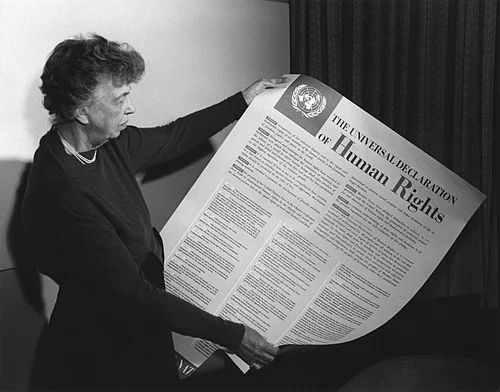
Eleanor Roosevelt, 1949
Kindertransport 1938-1939
The Evian Conference of July 1938 failed to produce a coordinated international response to the growing refugee crisis caused by Nazi persecution. Following the escalation of anti-Jewish violence during Kristallnacht in November 1938, non-state actors, including community organisations and private individuals, stepped in to facilitate the rescue and resettlement of refugee children in the United Kingdom. Nearly 10,000 children, most of them Jewish, were able to escape persecution in Germany, Austria, and Czechoslovakia through the Kindertransport programme. The British government facilitated the initiative by relaxing normal immigration requirements and granting temporary admission to child refugees. Responsibility for funding and supporting the children fell largely to Jewish organisations and other charitable groups, which provided financial guarantees and arranged accommodation. The children were placed in foster homes, schools, hostels, and on farms across Britain, while smaller child-refugee programmes also operated in Belgium, France, the Netherlands, Sweden, and Switzerland. Although the Kindertransport rescued approximately 10,000 predominantly Jewish children, most travelled without their parents, many of whose parents were later murdered in the Holocaust.”

German-Jewish refugee children arrive at Southampton, March 1939
Evian Conference 1938
In July 1938, delegates from 32 countries met in Évian-les-Bains, France, at the initiative of U.S. President Franklin D. Roosevelt to address the growing refugee crisis resulting from the persecution of Jews and other groups in Nazi Germany and Austria.The purpose of the conference was to encourage participating countries to accept Jewish refugees and to influence Germany to develop a comprehensive emigration system. The conference was, however, a failure, as most participating states declined to make significant commitments to increase refugee admissions.”
Head of the British delegation, Lord Winterton, remarked: “It has been the traditional policy of successive British Governments to offer asylum to persons who, for political, racial or religious reasons, have had to leave their own countries. The United Kingdom has never had cause to regret this policy, and refugees have often enriched the life and contributed to the prosperity of the British people. But the United Kingdom is not a country of immigration. It is highly industrialized, fully populated and is still faced with the problem of unemployment. For economic and social reasons, the traditional policy of granting asylum can only be applied within narrow limits.”

July 8, 1938 – French delegate Henri Berenger, US delegate Myron Taylor, and British delegate Lord Winterton
Aliens Restriction Act 1914
Enacted the day following the United Kingdom’s declaration of war on Germany, Parliament passed the 1914 Aliens Restriction Act, conferring exceptional power upon the Home Secretary to expand restrictions upon immigrants during times of war. Expanding the 1905 Aliens Act, it granted the state powers to prohibit entrance, determine places of residence, deny access to leave the country, and enforce deportations of immigrants. It further ordered that contravention or failure to comply with these restrictions would result in fines or six months imprisonment, with or without hard labour.
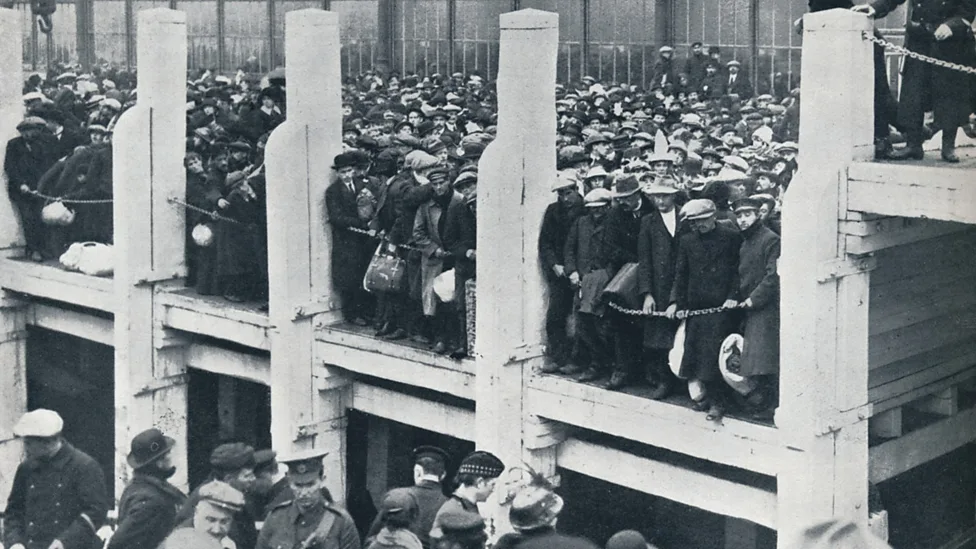
1914, Belgian refugees await a boat to take them to England
Aliens Act 1905
The 1905 Aliens Act marked a historic shift in the regulation and restriction of migrants entering Britain, introducing the concept of the “undesirable immigrant” into British law for the first time. Although the Aliens Act 1836 established requirements that entrants register with British authorities upon arrival, this legislation was largely unimplemented and generally forgotten by the end of the nineteenth century. Thus, Britain lacked a comprehensive system of migrant registration and documentation, much less restrictive immigration policies.
Historians agree that the 1905 Act was created in large part to control the influx in immigration of Eastern European Jews. In 1887, Labour correspondent for the Board of Trade, John Burnett, wrote that “thousands of native workers’ had been brought ‘to the verge of destitution’ by the recent ‘enormous influx of pauper foreigners … chiefly German and Russian Jews” demonstrating the prevailing antisemitism at the turn of the century.
The “undesirable Immigrant” was defined as he who (a) “cannot show that he has in his possession or is in a position to obtain the means of decently supporting himself and his dependents”; (b) “is a lunatic or an idiot, or owing to any disease or infirmity appears likely to become a charge upon the rates or otherwise a detriment to the public”; or (c) “has been sentenced in a foreign country with which there is an extradition treaty for a crime.” This legislation does not specifically refer to Jews, but in reality Eastern European Jews fleeing persecution comprised a large portion of entrants to Britain at the time under the Act’s definition of “immigrants” and are widely agreed to be the target of the 1905 Aliens Act.
While the 1905 legislation served to restrict immigration to Britain and exclude populations deemed undesirable, it also assures that “in the case of an immigrant who proves that he is seeking admission to this country solely to avoid prosecution or punishment on religious or political grounds or for an offence of a political character, or persecution, involving danger of imprisonment or danger to life or limb, on account of religious belief, leave to land shall not be refused.” Although asylum claims were often denied, this nevertheless marks a momentous development, codifying the right to asylum in the UK.