Access to food is about more than having enough to eat. Food enables people to participate in family life, community life, cultural traditions, and religious practice. It shapes dignity, belonging, and identity. Yet discussions about food insecurity often focus only on affordability and hunger.
René Cassin’s new report, ‘Food, Dignity and Belonging: Jewish Experiences of Food Access and Human Rights in the United Kingdom’, examines how food access is experienced through the lens of Jewish life and what these experiences can teach us about the wider movement for a Right to Food in the United Kingdom.
Drawing on evidence gathered as part of the Right to Food UK Commission, the report explores how food systems can fail even when food is available, and why food adequacy must be understood as an essential component of human dignity.
Read our full report here
Read our submission to the UK Right to Food Commission here
A Contribution to the Right to Food Movement
This report supports the recommendations and roadmap of the UK Right to Food Commission. It proceeds from the Commission’s central insight that food insecurity is not solely the result of individual circumstances, but of wider economic, social, and political systems that prevent people from accessing adequate food with dignity.
The evidence gathered by René Cassin suggests that discussions of food insecurity must go further still. Whilst affordability and income remain critical factors, food access cannot be understood solely through economic measures. Food is also a means through which people participate in family life, community life, cultural traditions, and religious practice. As a result, a person’s experience of food insecurity is often shaped by aspects of their identity, community, and circumstances that are not immediately visible in headline statistics.
A central finding of this report is that Jewish people are not experiencing a different form of poverty. Rather, they are experiencing poverty through the lens of a minority cultural and religious identity. The barriers described by respondents emerge from many of the same pressures affecting households across the United Kingdom, but are often compounded by the additional realities of maintaining religious and cultural life. Similar themes emerged in conversations with Muslim, Sikh, Hindu, Christian, and Bahá’í respondents, suggesting that these experiences are part of a broader challenge facing diverse communities throughout the UK.
Recommendations
Alongside support for a UK Right to Food Act and the wider recommendations of the UK Right to Food Commission, the report calls for:
- Recognition of cultural and religious adequacy as part of the right to food.
- Better consultation with minority communities.
- Improved training for frontline staff and food providers.
- Food provision that meets both religious and medical needs.
- Stronger accountability and routes for feedback and redress.
- Greater collaboration between public institutions, charities, and faith communities.
We Welcome Your Feedback
We welcome feedback from practitioners, policymakers, community organisations, faith groups, and human rights advocates. We are particularly interested in:
- Endorsements.
- Reflections on the findings.
- Examples of good practice.
- Suggestions for future advocacy and collaboration.
Please send comments, endorsements, or reflections to: info@renecassin.org
We are also happy to provide the report in alternative and accessible formats. If you require an accessible version, please get in touch and we will do our best to accommodate your needs.
Endorsements
“I thank René Cassin for its invaluable input into the Right to Food UK Commission final report, ‘A Roadmap to Delivering Food Security to All by 2035’, which makes it clear that ending food insecurity must not only take into account people’s income, employment and wider economic circumstances, but also their culture and personal background. This means ensuring that people of all faiths, ethnicities and cultural backgrounds can access food that is culturally appropriate. This excellent report by René Cassin highlights the importance of establishing this in a future Right to Food, and I’m pleased to endorse its findings and look forward to continuing our work together.” – Ian Byrne MP
“This initiative by René Cassin regarding the right to food in the UK is a very timely and vital clarion call, on behalf of the countless silent people in these Islands that are suffering for numerous reasons, by being deprived of the very basic human right of having sufficient access to food. In the Torah we are constantly taught and enjoined that we all have a duty to ensure that everyone without exception has immediate access to proper and suitable nutrition.” – Rabbi Herschel Gluck OBE
“In the UK our right to food is protected in international law. But as this important report highlights, that right is not a reality for far too many people in the UK. The work undertaken by René Cassin brings to the forefront the immediate and particular challenges faced by our religious communities, particularly Jewish communities, in the UK in accessing the right to food. This report provides vital learning and very practical steps for how we can work to better make sure the right of everyone in the UK to food is better achieved – including by ensuring we are considering and consulting with those who face particular barriers. The learning, while focused on the experience of religious communities is applicable across a wide range of groups with specific needs. We are grateful to René Cassin for this valuable work.” – Helen Flynn, Head of Programmes and Partnerships, Just Fair
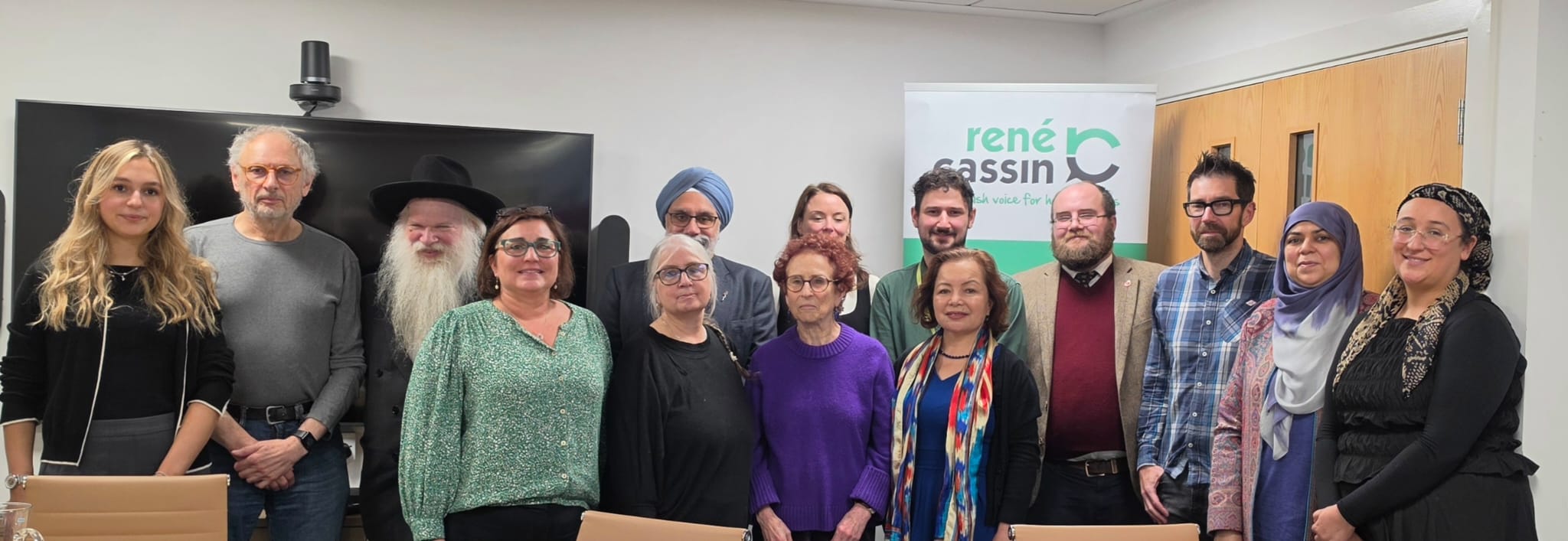
Photo from our Report Launch. René Cassin, November 2026.